The Situation
Engineering work in GMP manufacturing involves interpreting technical requirements, evaluating changes, and making decisions that can affect product quality, process performance, and regulatory compliance. Much of this work requires gathering information from multiple sources, including site procedures and policies, equipment specifications, vendor documentation, technical reports, historical data, and production records. Maintaining consistency across these sources can be challenging, especially as requirements change and documents are developed by different authors.
I began using Microsoft Copilot to explore how AI could help manage this complexity, improve the quality and consistency of technical work, and reduce time spent on repetitive activities. The objective was to strengthen engineering work without replacing technical judgment or established quality processes and standards.
The Challenge
One area with significant potential for improvement was the generation and review of engineering documentation. Equipment qualification protocols, process instructions, batch production records, and related GMP documents needed to be accurate, consistent with governing requirements and standards, and practical for engineers and manufacturing operators to execute with minimal errors.
Changing templates, evolving requirements, differences in writing styles, and information spread across multiple documents often created inconsistencies and additional review cycles.
The challenge was to develop a more consistent, reliable, and faster approach to prepare engineering and manufacturing documents while ensuring that AI-generated recommendations were technically sound and independently verified.
My Approach
1. Streamlining Engineering Documentation Workflows
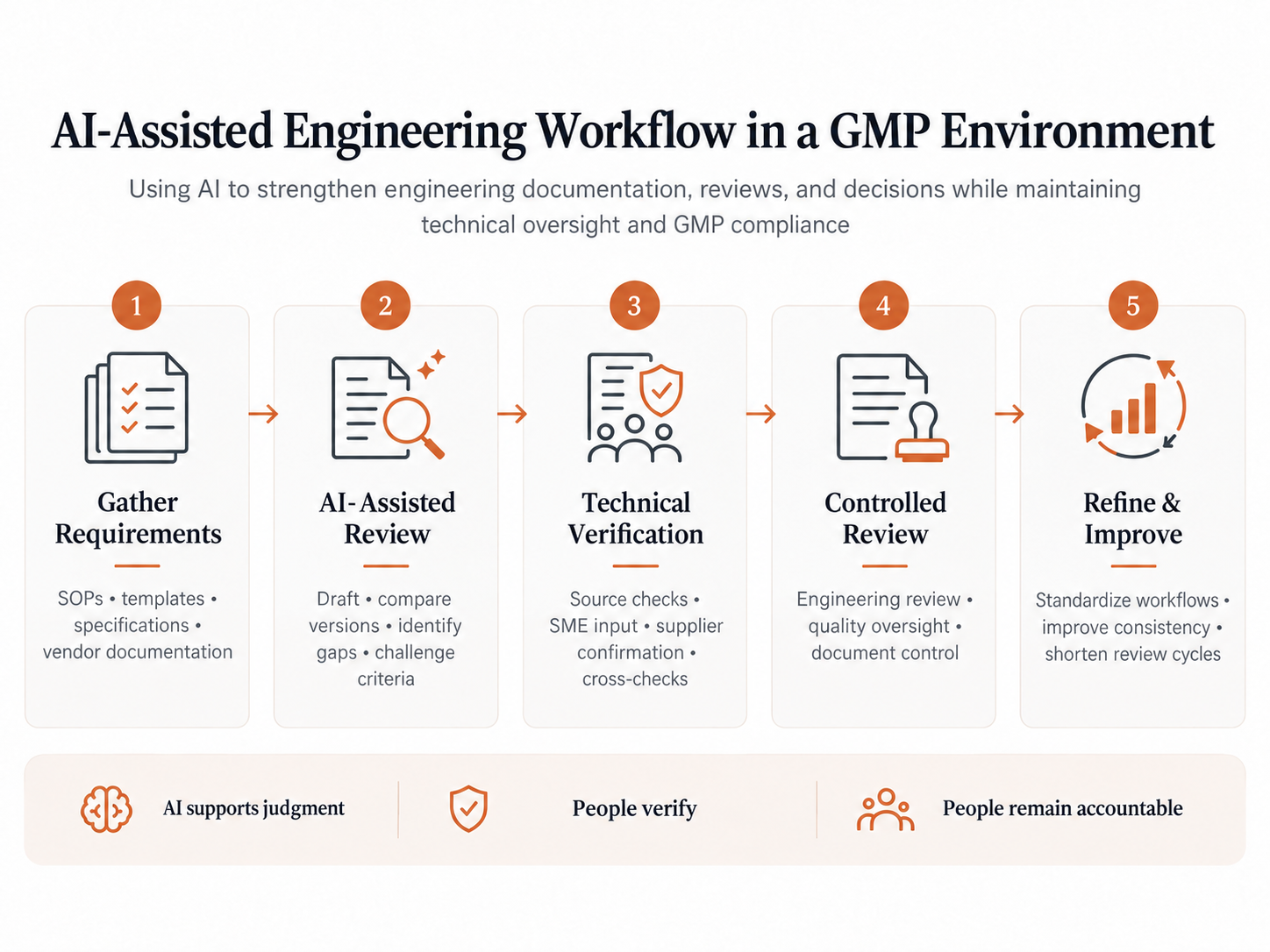
I developed reusable Copilot prompts to support the creation and review of engineering documents, including qualification and validation protocols, process instructions, batch records, and supporting forms. These prompts incorporated current templates, previously approved documents, governing Standard Operating Procedures (SOPs), equipment specifications, and vendor documentation.
I iteratively refined these prompts using additional references, including equipment manuals, drawings, technical specifications, troubleshooting guides, and feedback from subject matter experts (SMEs) and suppliers.
Beyond drafting, I used AI to challenge acceptance criteria, evaluate whether test instructions and methods were practical, and identify potential gaps in protocols, reports, and technical proposals.
I also used Copilot to compare documents for conflicting instructions, such as differences between process instructions and batch records, or misalignment between governing SOPs and site policies.
2. Strengthening Technical Reviews and Risk Assessments
I expanded the use of Copilot beyond documentation to support technical investigations, risk assessments, and engineering decisions.
For deviations and investigations, I used AI to evaluate available information, explore alternative explanations, and challenge proposed corrective and preventive actions (CAPAs).
For risk assessments, I used it to evaluate potential failure scenarios during operations and question whether proposed controls and mitigations were technically feasible and practical to implement.
I also used AI to evaluate proposed material specifications, alternative materials, equipment capabilities, and manufacturing process flows. This included exploring potential constraints, identifying dependencies, and considering the implications of proposed changes across other operations and equipment.
3. Supporting Continuous Improvement and Technical Communication
Other applications included identifying potential process improvement opportunities, exploring appropriate methods for data analysis, structuring presentations for senior leadership, reviewing supplier contracts, and preparing for technical discussions.
AI helped organize complex information often from multiple sources, compare alternatives, and identify issues requiring further engineering attention.
Verification and Quality Oversight
AI-generated recommendations could appear reasonable and confident while being incomplete, inaccurate, or impractical to implement. I verified recommendations and their supporting references against internal procedures, applicable standards, specifications, and original source documents. I also consulted colleagues and SMEs to challenge assumptions and assess feasibility. When necessary, I contacted equipment manufacturers and vendors to confirm alignment with specifications and operating limitations.
When evaluating proprietary company information, I used the company-approved Copilot environment. I also used Gemini for broader technical searches and checks that did not involve sensitive or confidential data.
AI-generated analyses and recommendations were subject to independent review by colleagues. As a team, we also agreed to inform reviewers when AI had been used so that output could be appropriately vetted.
I used AI to support the preparation and evaluation of technical work, while engineering decisions, review, and approval remained under human control.
Results and Improvements
Integrating AI into our workflows produced several practical improvements:
- Reduced document cycle times (drafting through approvals) by more than 50% through reusable prompts, standardized templates, and more consistent drafting and review processes.
- Improved documentation quality through more systematic reviews of potential gaps, conflicting instructions, and misalignment with governing procedures and document control guidelines.
- Improved consistency across qualification protocols and other engineering documents, reducing variation between individual authors and supporting more efficient reviews.
- Identified opportunities to strengthen execution instructions, troubleshooting guidance, and technical justification.
- Simplified document processing through collaboration with Document Control, resulting in noticeably fewer back-and-forth review cycles.
- Strengthened technical evaluations by introducing additional perspectives, challenging assumptions, and identifying issues requiring further investigation.
Lessons Learned
Start with reliable technical requirements.
The usefulness of AI depended heavily on the quality and relevance of the information provided. Unreliable or inaccurate input yielded similarly unreliable recommendations from AI tools. Current specifications, governing procedures, approved examples and references, and clear technical constraints were essential to generating meaningful output.
Use AI to challenge assumptions and not simply confirm them.
Some of the most useful applications involved questioning acceptance criteria for protocols, investigating inconsistencies, evaluating potential failure modes and risks, and identifying weaknesses in proposed solutions and plans.
Standardize the workflow and not just the document.
Reusable prompts, consistent reference materials, and repeatable approaches to reviews improved efficiency and consistency in documents. This also reduced unnecessary variation among authors.
Verify recommendations against actual operating conditions and requirements.
An AI-generated recommendation could appear technically reasonable but fail to account for actual equipment limitations, operating conditions, or facility-specific requirements. It was essential to keep SMEs directly involved with planning and verification to ensure recommendations were feasible, accurate, and appropriate for our use cases.
Make AI use transparent and preserve accountability.
AI assisted in preparing and evaluating technical work while people remained responsible for the decisions, approvals, and quality implications. Independent review and transparency helped maintain appropriate oversight across the team.
Overall Perspective
My experience reinforced that AI can provide meaningful value in engineering work beyond generating documents, summarizing information, or analyzing large data sets.
When applied thoughtfully, AI can help identify inconsistencies, clarify complex technical problems, challenge assumptions, streamline workflows, and support more informed engineering decisions.